





The Pricing Paradox: Why Do We Buy Jewellery by the Gram, But Art by the Heart?
Last month, while traveling, I found myself captivated by a beautiful, handwoven, hand-dyed Pashmina shawl. It was a masterpiece of subtle texture coupled with vibrant colour. When the owner told me the price, it was significantly high—and she said it completely unapologetically.
As I contemplated the purchase, a realization hit me: here I was, entirely willing to invest in this piece without once weighing it against a metric of actual wool or dye cost. I wasn't doing math about raw commodity prices; I was simply appreciating her art, her time, and her vision.
Then the inevitable thought followed: Why do we fail to apply this exact same principle to jewellery in India?
As the founder of Solv, this pricing paradox is something I confront daily. India has a deep-rooted relationship with precious metals, historically viewing them as a liquid financial safety net. Because of this, the consumer became hardwired to look at jewellery through the lens of a commodity trader. It remains the only creative industry where the retail price is expected to be tethered almost entirely to the baseline weight of its raw ingredients.
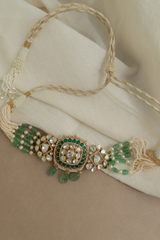
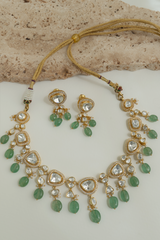
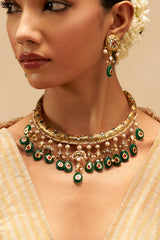
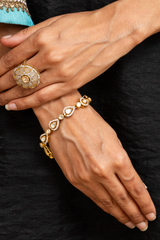
Take, for instance, our Gauri Navratna Choker—one of my absolute favourite pieces. It is a fresh, highly geometric representation of a centuries-old tradition. While it is incredibly loved by many, the question I am most frequently asked is: “Why is it priced this way?”
The answer lies entirely in the human hands behind it. To create a piece like this, we must first source coloured stones that perfectly complement one another. Then, each stone is precisely cut into a custom geometric shape and meticulously hand-carved to achieve its flawless finish. This entire process is done purely by hand; no machine can intervene. It is the price of a painstaking, invisible process that traditional valuation completely leaves unaccounted for.
A rigid metric of weight entirely eliminates the hours spent on intensive prototyping and the careful details required to blend different metals with structural precision. As a founder, the question I often find myself asking is: Do I stop investing my time and energy into these true, one-of-a-kind pieces simply because their pricing is entirely skill-based, or do we continue to challenge and change the consumer mindset around what jewellery should be?
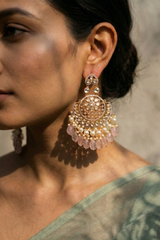
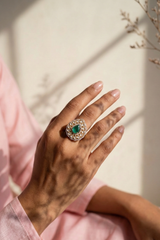
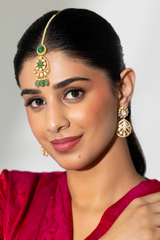
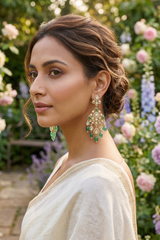
I started Solv with the belief that you aren't just buying gold, silver, or gemstones. You are investing in creative intellectual property—the months spent sketching so a piece sits perfectly on your skin. You are investing in the artisan who finishes each edge to give the metal its understated texture and every gemstone its unique finish. Traditional pricing models may penalize this labour, but I will always choose to value the artistry over the mass.
As a consumer I feel that the modern Indian collector is changing, shifting away from sheer bulk toward an appreciation for form, concept, and ergonomics.
So, as a collector and lover of art, I urge you to look past the scale the next time a piece of jewellery speaks to you. celebrate its lines, its structure, and its story. Jewellery, at its core, is a dialogue between the creator and the wearer. Just like that handwoven shawl, you are carrying a piece of someone’s imagination—and true artistry can never be measured by the gram.
Is it an Heirloom if it Doesn't Tell a Story? Rethinking What We Pass Down.
Preserving the Karigar: Why Traditional Jewellery Making is Our Living Heritage
Related Posts

Preserving the Karigar: Why Traditional Jewellery Making is Our Living Heritage

Is it an Heirloom if it Doesn't Tell a Story? Rethinking What We Pass Down.

A Metal with History: Why I Build Solv on 925 Silver

Just Your Luck: Why Silver Is Considered Lucky in Indian Astrology


